

|
|
| Home |
1984/85 | Previous | Next |
 |
|
by JAMES MOSSOP STROLLER was a famous Scottish footballer who acquired that name through his gentle touch - a tender caressing of the ball as he stroked it around the pitches of the world with an art of his own. Stroller is now resident in the notoriously tough and scruffy dockland area of South-East London that houses Third Division Millwall in the aptly named Cold Blow Lane. “Stroller” is George Graham, whose efforts at making Millwall respectable and successful grow more exceptional by the day. Everything he learned in a career that took him from the outskirts of Glasgow to Aston Villa, Chelsea, Arsenal, Manchester United, Portsmouth. Crystal Palace, Queen's Park Rangers and a dozen Scottish caps, is being used in the quiet Millwall revolution. From the foot of the Third Division, where they had to win 12 of their last 15 matches to survive after he arrived in December 1982, Millwall are now pushing towards the Second Division. The style has changed. The players have changed, and 38-year-old Graham is working at changing the minds of some of the ferociously demented louts—one recent violation was to swipe a knife through the leather jacket of Chelsea reserve, Robert Isaac with a blow so severe that his body required 55 stitches. Talking sense to such culprits is not easy, as Graham explains: “I met a group of spectators after one match and we talked for hours. But to half of them I might just as well have been banging my head against a wall. “The sadness is that out of 5,000 regular supporters there are 100 who cause trouble. I suppose they represent that degree of open lawlessness that exists in Britain today.” “We don't want them here and nor do the other supporters who are mainly docklands people and, although they are noisy and critical, they are the salt of the earth.” “I want the team to be fully professional in everything they do and if we can get things right with the team, I am sure it will spread to the crowd.” Graham's style of getting things right has won him praise and recognition in boardrooms higher up the League. He could soon find himself receiving offers. He is a shrewd coach, a demanding manager and, surprisingly, a regular visitor to Companies House where he can familiarise himself with football's balance sheets - essential knowledge if you are trading in the transfer market or considering a new job, he says. |
His preparation for management was just as thorough. As a young player at Chelsea he could usually be found after training sitting in a corner cafe in the depths of serious debate with Terry Venables, John Hollins and Ron Harris. Talking football, he says, has always been one of his hobbles and it still upset s him to see today's players end their training, jump into their cars and dash off in different directions as quickly as possible. Venables, remembering those young days of enthusiasm, gave Graham a coaching chance at Palace when he was thinking of taking a pub after breaking a leg and then an ankle as his playing days evaporated. He took charge of the youth team. “It was rewarding,” he said. “These were youngsters learning their trade. As a carpenter has to master the plane and the chisel these boys had to master the tool of their trade, the football.” “I had taught myself that essential control as a wee boy by playing every available hour in a place called Bargeddie, just outside Glasgow.” There he was the youngest of six children - four boys and two girls - whose father died of tuberculosis when George was two weeks old. Life was never easy. Perhaps that upbringing has made him wary of football's new breed, of whiz-kid chairmen – “men on ego trips who think they can manage clubs themselves"—and quick success. He thinks it has made him wary. Perhaps, too, it made him determined to learn the basics of football management before she plunged in himself. He found that experience at QPR, again under Venables, where he was given the youth side and a stringent budget. “I knew I would never be satisfied being a lieutenant,” he said. As a player, I was always fancying new challenges, and felt I was ready for Millwall. “It was always going to be difficult to stay up with so many matches to be won, but I remember something that happened during our double year of 1971 with Arsenal. It was Easter and we were all watching TV with Bertie Mee and Don Howe.” “On the screen several managers were asked who would win the First Division. They all said Leeds United. Bertie and Don told us to Ignore it and just concentrate on the next match. We won the League.” |
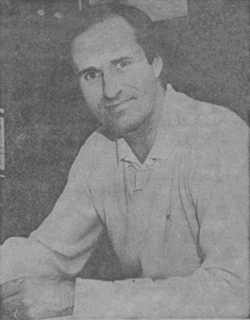 ● George Graham: A shrewd coach and a demanding manager. “That first season at Millwall we had to play hard, uncompromising football. In our position we needed fighters. In a way I had to shelve my principles because I believe in creative, entertaining football. I like to attack. I like to say to my players Let's go”. That style is now decorating Millwall's play. Only three of the players Graham inherited remain and there is bustle and pride running through the old, club. “How far can we go?” he asks himself. “I don't know but we are on the right lines. Millwall is something special; there is a passion you don't normally see in most parts of the south, it reminds me of Glasgow and Liverpool.” “I have a terrific relationship with the chairman, Alan Thorne, and I would like to give them some success, as next year is the club's centenary.” “It annoyed me to hear Jimmy Greaves and Malcolm Macdonald suggesting that the Third and Fourth Divisions could easily be done away with. Why? Wimbledon get small crowds and budget accordingly. They have gone from the Fourth to the Second. If they can do it, so can others if properly managed. Banish the Third and Fourth Divisions and there would be no more Watford and Swansea stories.” Some days George Graham loses himself in other worlds. Whether he is moving quietly among the shrubs and roses in his North London garden, or on his fortnightly trip to a West End theatre with his wife Marie, his thoughts often return to football and his ambition to be a top manager. He will get there because he has drive. He is energetic, enthusiastic. He gets things done apace - and all the time you think he is strolling. |